
Automatic Sleeve Wrapper Machine for Bottles & Multipacks (Up to 30 Packs/Min)
If you are still using cartons for secondary packaging, you may be losing profit margin to unnecessary material waste.
This high-performance automatic sleeve wrapper machine is the industry standard for high-speed sleeve wrapping machine lines in beverage and bottling facilities. Engineered for 24/7 industrial uptime, our sleeve wrap equipment helps manufacturers achieve a 60–70% reduction in secondary packaging costs while ensuring maximum pallet stability.
Automatic Sleeve Wrapper Machine for Bottles & Multipacks (Up to 30 Packs/Min)
This high-performance automatic sleeve wrapper machine is the industry standard for high-speed sleeve wrapping machine lines in beverage and bottling facilities. Engineered for 24/7 industrial uptime, our sleeve wrap equipment helps manufacturers achieve a 60–70% reduction in secondary packaging costs while ensuring maximum pallet stability.
What Is an Automatic Sleeve Wrapper Machine?
ROI Analysis: Calculate Your Payback Period
Before diving into the machine features, you must understand the financial impact of switching from cartons to an automated sleeve wrapper.
The Cost Logic
Average packaging cost drops from $0.35/bundle (cartons) to $0.10/bundle (PE film).
Typical Payback
Most of our clients see a full ROI within 180–360 days solely through material and labor savings.
Case Evidence
A 10,000 BPH bottled water factory eliminated tray usage entirely by switching to trayless bundling, saving thousands in monthly logistics and storage.
Send us your daily output and current carton costs
We will calculate your exact monthly savings and machine payback period.
Automatic vs Semi-Automatic Sleeve Wrapper
Choosing the right sleeve wrapper depends on your production volume, labor cost, and level of automation.
| Feature | Semi-Automatic Sleeve Wrapper | Fully Automatic Sleeve Wrapper |
|---|---|---|
| Feeding Method | Manual loading with mechanical pushing | Automatic feeding and grouping |
| Automation Level | Partial automation | Full automation (PLC controlled) |
| Production Volume | Small to medium batches | Mass production / high capacity |
| Flexibility | Extremely high; fits various sizes and shapes | Best for standardized, uniform products |
| Labor Requirement | Higher; requires at least one operator | Lower; minimal operator intervention (mainly film replacement & monitoring) |
| Initial Investment | Lower (approx. USD 3400+) | Higher (typically depends on line configuration) |
| Packaging Speed | 8-10 packs per minute | 5–8 bundles per minute (multi-pack grouping, higher total output) |
| Space & Layout | Compact and mobile | Occupies more space; integrated with lines |
How to Choose the Right Sleeve Wrapping Equipment
Choose Semi-Automatic if:
- Output < 10 packs/min
- Multiple product sizes
- Lower budget
- Manual flexibility needed
Choose Fully Automatic if:
- Continuous production line
- High volume (3000+ bottles/hour)
- Reduce labor cost
- Need full line integration
Get Your Recommendation
Applications of Sleeve Wrapping Machines in Bottling & Packaging
Tengyi sleeve wrapping systems are used across a wide range of industrial packaging environments. They are often selected to reduce secondary packaging material use, improve bundle stability, and increase end-of-line efficiency.
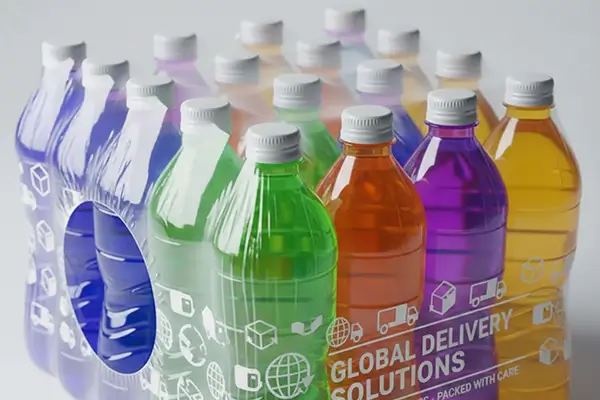
Beverages and bottled water
PET bottles, glass bottles, aluminum cans, juice cartons, with or without trays
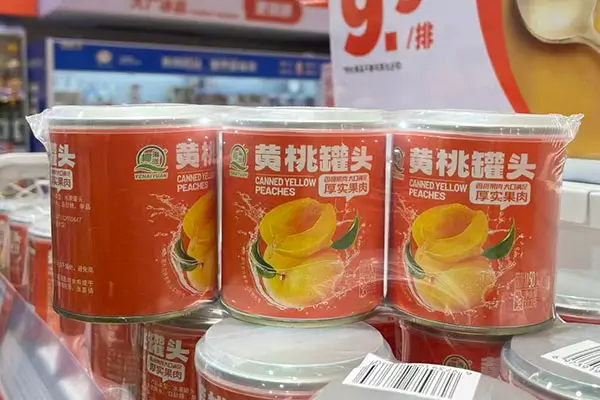
Food and dairy
Canned food, Tetra Pak cartons, yogurt cups, condiment bottles

Logistics and e-commerce
Cartons and bulk items for warehouse distribution
Engineering Decision Framework: Which Model Fits Your Line?
To help you make an immediate decision, we have simplified the selection process based on your real-world production requirements.
Step 1: Define Your Production Scale
< 10 packs/min: TY-P500 (Semi-Automatic)
Best for flexible, small-batch runs.
10–20 packs/min: TY-800A (Fully Automatic)
Best for mid-sized beverage and FMCG lines.
20–30+ packs/min: DLL-450A (High-Speed Inline)
Mandatory for large-scale, 24/7 bottled water plants.
Step 2: When NOT to Choose a Sleeve Wrapper
We value your line efficiency over a quick sale. Do NOT choose this auto sleeve wrapper if:
Your product requires 100% air-tight retail packaging (use a full-enclosure shrink wrapper instead).
Your product is highly unstable without the structural support of a full cardboard carton.
Your production volume is less than 2,000 packs per day (the ROI will be too slow).
Tengyi Sleeve Wrapping Machine Series Overview
Tengyi offers multiple sleeve wrapping machine models to match different production volumes, automation needs, and line integration requirements. Model selection is typically based on output targets, product type, and available floor space.
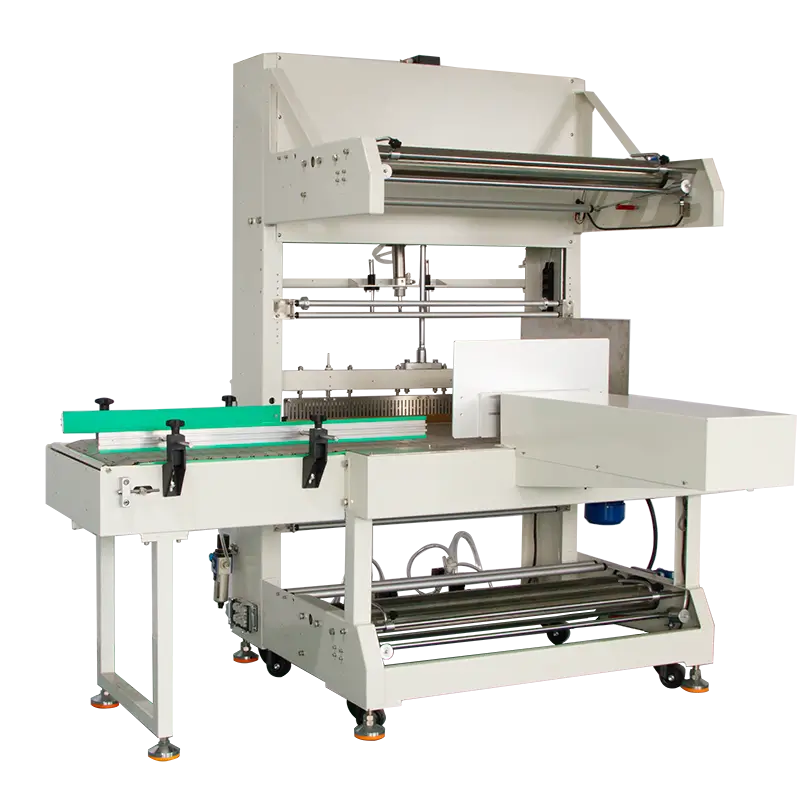
Fully Automatic Sleeve Wrapping Machine-TY-800A
- Integrated automatic grouping unit
- No manual stacking during normal operation
- Supports common layouts such as 2×3 and 3×4
- Suitable for bottles and cartons
- Often selected when upgrading from semi-automatic systems
Typically paired with the TY-6040 PE Heat Shrink Tunnel for automatic PE shrink packaging
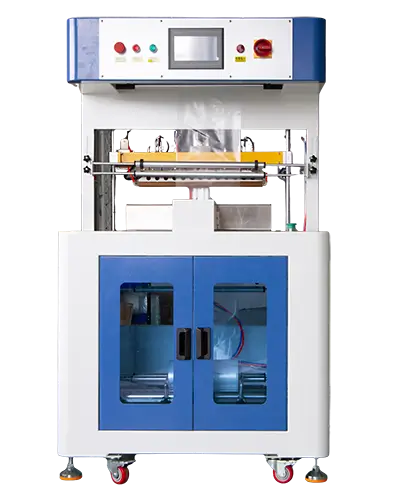
Semi-Automatic Sleeve Wrapping Machine-TY-P500
Automation level: Semi-automatic
Typical output: Approximately 8–10 packs per minute
Typical applications
- Contract packers and craft beverage producers
- Facilities with frequent format changes or short production runs
System characteristics
- Manual product loading
- Button-controlled sealing and cutting cycle
- Optional photoelectric sensing upgrade
- Lower initial investment compared with fully automatic systems
- High flexibility for mixed or changing pack formats
Linear Trayless Shrink Wrapper-DLL-450A
Automation level: Fully automatic, inline
Typical output: Up to approximately 20–30 packs per minute
Typical applications
- Large-scale beverage lines with continuous operation
- Standardized containers such as water, soft drinks, and beer bottles
Automatic Trayless Multipacks: Efficiently bundles bottles into 6, 12, or 24-packs without the need for cardboard trays or bases, significantly reducing material costs.
System characteristics
- Inline integration with automatic lane dividing
- Servo-driven motion for continuous operation
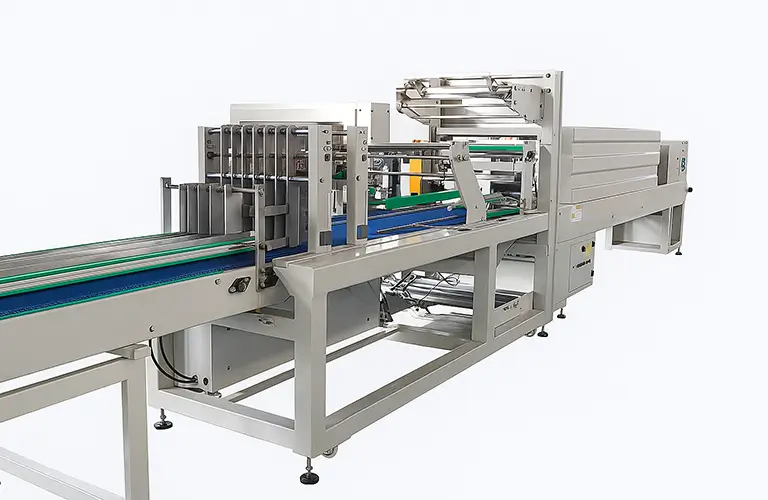
- Covers conveying, alignment, grouping, wrapping, shrinking, cooling, and downstream transfer
- Designed for high-throughput end-of-line environments
How a Sleeve Wrapping System Operates
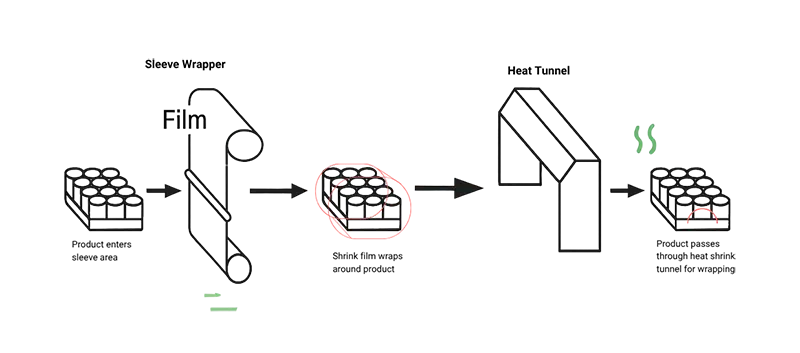
Infeed and Collation
Products enter via conveyor. Automatic models use guides and sensors to form defined patterns.
Film Draping
Two film rolls drape over the product flow to form a loose sleeve.
Sealing and Cutting
A heated alloy blade cuts and seals in one motion, supporting continuous operation.
Shrinking and Cooling
The sealed bundle enters a PE heat shrink tunnel, where hot air shrinks the film for a tight, secure finish before cooling.
Recommended Heat Tunnel: TY-6040 Industrial PE Heat Shrink Tunnel →
Technical Specifications & Industrial Benchmarks
This table provides the physical and electrical boundaries required for your facility planning.
★ Most customers choose DLL-450A for high-speed production
| Parameter | TY-P500 (Semi-Auto) | TY-800A (Automatic) | DLL-450A (High-Speed) |
|---|---|---|---|
| Output Speed | 8–10 packs/min | 5–8 bundles/min | 20–30+ packs/min |
| Control System | Relay / Basic PLC | Mitsubishi PLC | Mitsubishi PLC + Servo |
| Drive System | Pneumatic | Pneumatic + Motor | Full Servo Driven |
| Max Bundle Size | Customizable | Customizable | Inline Standardized |
| Film Type | PE | PE | Heavy-duty PE |
| Power Supply | 220V / 380V | 380V Industrial | 380V Industrial |
| Air Requirement | Required | Required | Minimal / Optional |
| Line Integration | Standalone | Semi-inline | Fully Inline |
Recommended Heat Shrink Tunnel
For automatic sleeve wrapping using PE film, we recommend pairing this machine with the TY-6040 Industrial PE Heat Shrink Tunnel.
Its 1800 mm heating chamber and integrated cooling system provide the residence time required for proper PE film shrinkage in continuous production.

Why Precision Matters: Servo vs. Pneumatic Systems
For 24/7 high-speed stability, the choice between a servo and a pneumatic sleeve wrapping machine is your most critical ROI factor.
Positioning Accuracy
Our servo systems achieve 0.1 mm precision, preventing film jams and misaligned seals common in pneumatic systems (which fluctuate by 2-3 mm).
Stable Output vs. Peak Speed
While others advertise "peak speed," we focus on stable output. Servo drives reduce micro-stoppages by 30–50%, ensuring your actual shift production meets your targets.
Production Line Integration: More Than Just a Machine
To achieve the 65% cost reduction mentioned above, your automated sleeve wrapper must work as part of a system. A complete sleeve wrapping solution includes:
Proven Reliability: Serving Global B2B Leaders
This table provides the physical and electrical boundaries required for your facility planning.
See How Sleeve Shrink Machines Perform in Real Production
FAQ: Critical Buyer Insights
What differentiates a sleeve wrapper from a bundle wrapper?
The terms “sleeve wrapper” and “bundle wrapper” are often confused. Both generally refer to a machine that groups several pieces of product with a thin, plastic film sleeve for handling and distributing or protecting.
What is the difference between sleeve wrapping and full shrink wrapping?
Sleeve wrapping leaves open ends, using less film and allowing airflow. Full wrap seals all sides.
What is a sleeve wrapping machine used for?
It bundles products using PE or PVC shrink film sleeves, commonly for bottles, cans, and cartons.
What are the main benefits of using a sleeve wrapper?
Key benefits include:
Integrated Film Wrapping, shrinking
Secure, tamper-evident packaging
Versatile product compatibility
Reduced cardboard waste and cost
What production speed can a sleeve wrapper machine achieve?
Typical speeds range from 8 to 30 packs per minute depending on model, product layout, and automation level.
Is a shrink tunnel required?
Yes.
After sealing, PE film must pass through a dedicated heat shrink tunnel to achieve proper shrinkage and package stability.
For PE sleeve wrapping applications, we recommend the TY-6040 Industrial PE Heat Shrink Tunnel, which features an extended heating chamber and integrated cooling system specifically designed for heavy-duty PE film.
What production speeds are typical?
- Semi-automatic: 8–10 packs/min
- Fully automatic: 5–8 bundles/min
- High-speed inline: 20+ packs/min
What types of film are compatible with sleeve wrappers?
Most sleeve wrappers use polyethylene (PE) film. They can also work with PVC shrink film, and other shrinkable films.
Does the film brand matter for machine stability?
Yes. High-quality sleeve wrap equipment performs best with consistent film thickness. We provide a list of recommended global film suppliers to ensure zero-jam operation.
What is a "bullseye" and can it be adjusted?
The bullseye is the open side of the bundle. We can adjust the film width to customize the bullseye size based on your ventilation or transport needs.
Can I integrate this into an existing shrink wrap machine for bottles line?
Absolutely. Our systems are designed for modular integration with most standard beverage conveyors.
Do you provide installation and support?
Remote guidance, documentation, and optional on-site support are available.
Can machines be customized?
Yes. Layout, dimensions, and configuration can be adapted based on application needs.